|
St Marys works in 1902 (ex. libris Mr.
Hoehn)
Mr Hoehn1 describes the works:
"St. Marys is located due north of Interstate 80 in northwestern
Pennsylvania, about 30 miles from DuBois and about 50 miles south of the New
York State border."
"The Elk Fire Brick Co. was a specialized manufacturing entity
and a division of North American Refractories, Inc. This facility made special
brick shapes to fit into ladles for the steel making industry. That is every
shape to fit into the inside the pouring ladles suspended by cranes in steel
mill. There were multiple layers that fit inside each other and each layer
required tapered and curved bricks that fit like a picture puzzle into the
inside of the ladles. The high quality clay, and the fact that the vein was over
9 feet high helped to keep them competitive right into the 1960's."
"The problem faced by the company was to bring the clay down to the plant. There
was more than 300 ft. elevation difference between the mine portal and the
plant. The Byers was used to bring loaded clay cars down a portion of the grade
to the plant, while a cable and capstan arrangement brought them down the
steepest part of the hill."
"I believe that The Byers Company was responsible for the
original design, where the loaded cars pulled the empty cars back up to the mine
portal. This cable way used spring loaded switches at the middle of the cableway
and allowed the empties going up to pass the loaded cars coming down. The mine
portal was about 3/4 mile from the plant, so the locomotive ran on a maximum
grade of around 5% and careful inspection of the pictures will reveal shoe
brakes on the locomotive rather than the original Byers brake design on the
counter shaft. This allowed the loco to handle a maximum of 4 loaded cars on the
grade. The cableway portion had a grade of about 11% with double track at the
top and bottom, and as previously stated, spring loaded passing switches in the
middle of the run." (See topographical map further down on this page.)
"The 1902 plant photograph clearly shows the elevated track to
the left of the main plant. I was able to discuss this in detail with the son of
the plant manager before he died last year (2007). Mr. Boschert rode this
locomotive along with the engineer, a Mr. Mertle, although his father had
forbidden the practice. The steep part of the elevated track required a good
running start to push the 4 loaded clay cars up to the dumping point above the
grinding and mixing equipment."

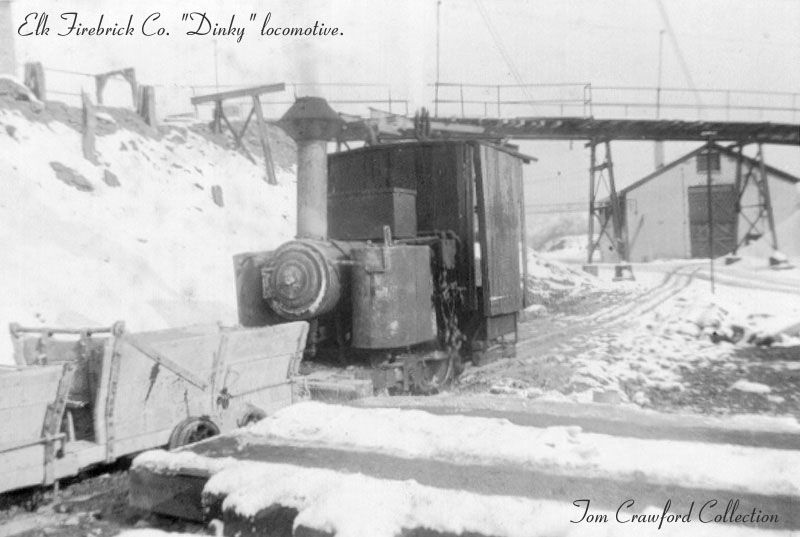
Dinky Locomotive
The Elk Fire Brick Co.'s aptly named "Dinky" locomotive was used
for about 50 years to haul clay wagons at the St. Marys plant in northwestern
Pennsylvania.
The Byers locomotive at work c. 1946 (image: Tom Crawford collection) .
The Byers locomotive at work c. 1946 (image: Tom Crawford collection) .
"This part of Pa. lies on the Allegheny
Plateau at about 1800 to 2300 ft above seal level. It is not unusual to have
winter temperatures of zero to minus 40 deg. F. as can be seen from the snow in
the pictures."
"This is the reason that a cab was
installed on the engine. This is constructed of tongue and groove lumber and
according to Mr. Boschert the Byers was delivered with the wooden T & G boards
already installed. The wood was originally varnished, but within a short time it
was painted with a dull grey paint that was used around the plant."
"Mr. Mertle (the engineer) was a tall man
and had a difficult time folding himself inside the cab to stay out of the
wind."
"These locomotive pictures show the
elevated track above the storage and repair track in the rear of the production
building."
"The Locomotive pictures (originals) are in
the possession of a Mr. Thomas Crawford. Both Mr. Crawford and Mr. Boschert have
given me their permission to use the scanned photos as I see fit. I see no
reason that you could not use them on your site, provided they get credit as the
owners."
Mining.
A miner at the Elk Firebrick Co.'s St Marys mine (ex. libris
Mr. Hoehn).
The St Marys Works
Elk Firebrick Co.'s St Marys works.2
(This image is linked directly
from St Marys
Antiques' website - please let me know if it disappears).
I found this image with a web search, and on receiving the
URL Mr Hoehn wrote:
"This is the "brickyard" that I remember. I grew up about 1/2
mile from the plant, and spent many days observing the goings on there. I was
tolerated because my father had been a "Water Boy" there in 1920. Also because
Mr. Boschert was a neighbour across the street."
"The picture offers the opportunity to describe the buildings and their
functions. Beginning on the extreme left, the building was a small office and
the shed on the rear was used to store straw for hand loading the bricks into
boxcars. The saw-tooth shed was used to store finished brick in a dry
environment. They were not damaged by water, but any moisture still in the brick
when placed in the ladles resulted in steam explosions and destruction of the
brick at the steel mill. Above the 4th saw-tooth shed, you can see the small
valley where the Byers went up the grade to the base of the cableway. There are
a series of small brick chimneys directly above the storage sheds. These are the
stacks of the bake ovens (about 4) toward the left (East) side of the plant.
Directly above these are two white buildings that housed the blacksmith shop and
the carpenter shop. Progressing toward the west, the higher building was the bin
for storing the raw clay as it came from the mine. Prior to this picture there
was a wooden raised roof on this part. The plant had installed a cable car
arrangement from another mine to the North (Directly behind the photographer and
about 1/4 mile from the plant). This vein is also at about the same elevation as
the other,and allowed the loaded gondolas to pull the empties directly back up
to the mine tipple."
"Continuing to the West, the last saw-tooth roof ends and you can see the arched
top of a brick kiln between it and the end of the box car. There were three
pairs of kilns on this end of the plant. Each large chimney is attached to two
kilns and there are damper plates the kiln operator can raise to open the draft
or lower to close the draft off from the stack. These kilns were "End Fired" as
opposed to the ones on the east that were side fired kilns. The design was such
that the heat was brought into the arch and then drawn down through the brick
load through holes in the floor of the kiln. Thus the entire kiln reaches a
uniform temperature as the heat is drawn down through the openings in the floor.
Brick and ceramics need to be very slowly dried of free and bound moisture, so
the abundant natural gas from local wells allowed the slow raising of the kiln
and load until all the moisture was driven out through the stack. Then the
operation switched over to coal, and there were firemen assigned to keep the
grates (about 16 on the side fires and 8 on the end fired kilns) Brick was fired
for 5 to 7 days on high fire, with the plant engineer monitoring the load
temperature by looking into a hole created by pulling out a single brick in the
laid up brick door. They used a sight tube of colored examples to compare the
glow (yellow color) to the sample thus estimating the kiln temperature."
"The main part of the plant had heated floors from steam lines buried in the
concrete. This was a favorite hang-out of hobos because they could hide in the
brick stacks and sleep very warm on the drying floor. The boiler house stacks
(2) are visible above the main building. The Byers was also connected to the
plant boiler at night to keep the water hot and easier to get moving in the
morning. To the right (West) of the box car are additional brick storage for
special shapes and the lumber storage for blocking in the brick loads in the box
cars."
"The main siding to the plant is very interesting. In 1846, the Redemporists
(Catholics from Germany) were sent by King Ludwig I of Bavaria to assist the
small group of immigrants in establishing a grist mill and a saw mill in the
area. These mills were located directly west of the plant location and only
several hundred yards distant. The siding is laid directly upon the old access
road to these mills and is quite steep. The H-9 and H-10 2-8-0 consolidation steam locomotives could only pull
one loaded brick car at a time up this grade. It was about 4% and there was very
little flat at the bottom to get a run for the hill. In the 1950's when the
first diesel locomotives tried to pull these loads out of the plant, they
frequently had to get a second engine to help bring even one loaded car up the
grade."
"The photographer is probably standing on the main line of the
PRR's Erie Division."
Topographical Map
Topographical map of the Elk Firebrick Co.'s St Marys
mine track (Mr. Hoehn).
"The track gauge is unusual for Byers per published
information."
"I spent an afternoon with a metal detector, locating
spikes that remain in the old ties on the hillside. I carefully marked the
inside edge of every spike for about 60 feet by locating with steel rods, and
then stringing a line between them. I carefully measured the distance between
the strings thus approximating the outside of the rail web for both rails. I
then went to a small railroad that currently uses 40 lb. rail and measured the
inside of rail to inside of rail (gauge) and subtracted the gauge dimension from
the outside web dimension."
"I had been told by some historical experts that this was a 30"
gauge railroad, and the dimensions that I found exactly correspond to a 30"
gauge railroad."
Additional...
"Mr. Boschert (the son of the plant manager) was
contacted about the "dinky", but he didn't have any details about the purchase.
I accidentally came across the Geared Steam page after I had the pictures from
Mr. Crawford. I put 2 and 2 together, and was able to take a print out of the
Byers information to Mr. Boschert before he passed away. He thought that this
locomotive and the ones from the Renovo operation went to Kovalchick Salvage for
scrapping, but he was not absolutely sure."
"A Mr. B Erich purchased the plant from N.A.
Refractories, but used the buildings to produce pre-cut homes, where the size of
the drying floor allowed entire walls to be assembled and loaded onto trailers
for transport to job sites. He said there were no files or papers when he took
over the operation."
"I have contacted the historical society in Ohio that
has information on Byers, but they did not have any information concerning the
engines. They did have data on cable cars and cable operated inclines, so I
would assume that both cable controlled systems were also designed by Byers."
In my correspondence with Mr Hoehn I mentioned about
the length of service of the Byers locomotive, which at about 50 years of
continuous daily operation (6 day weeks ?) is a long time. He replied:
"Your remark about the length of service struck me as
unusual. Then I really got to thinking about why it would have run so long. St.
Marys has been blessed with some good old German ingenuity over the years. We
were the main railroad shop for The Pittsburg, Shawmut & Northern Railroad. We
had a sand casting plant (Elk Engineering Works) and all the expertise with
steam locomotives that anyone could ask for. The "Shawmut" and its predecessors
Kaul Railroad; Buffalo, St. Marys & Southwestern; Clarion River Lumber Co.
and a lot more little lumbering railroads that kept their own power and rolling
stock operating. N.B. The seperate Kaul & Hall Lumber Co.'s lines were St. Marys
and Eastern and St. Marys and Western."
"Call up the Bucksgahuda & Western Railroad
on the net or take a look at "The Two
Footers" web page. This love of steam continues today in St. Marys, with a
couple of hobby railroads in 2' gauge. The B & W has a Henchel named Otto and a
home made Shay loco fired with oil. The Teaberry and Southern is the play toy of
the Krellner Brothers."
"Perhaps this explains why the Byers ran for so many years. I know that Gus said
there was a bad wreck with a run-away train, and I would assume that it took
considerable skill to repair the Byers after the wreck. This skill would only
have come from the PS & N Shops and the Elk Engineering Works"
"I hope this information will be of interest to you and
your readers."
Bill Hoehn (June 2008).
Information Sources
1. I am fortunate to have been
contacted by Mr. Hoehn with this
additional information about the Byers locomotive reproduced on this page, which
I have used verbatim* (all paragraphs in quotes "_" ).
* With minor edits as this
information is an amalgam from email correspondence.
>>> Copyright / Usage terms <<<
Mr Hoehn has kindly given permission for his information on this page
to be used as long as full credits are given.
2. St Marys Antiques - colour picture of Elk Firebrick Co.
|